How to Apply for a Business PAN Card in India
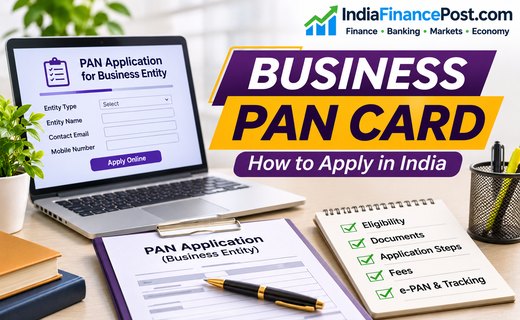
How to Apply for a Business PAN Card in India
How to Apply for a Business PAN Card in India is a common question among entrepreneurs opening bank accounts, registering businesses or meeting income-tax requirements.
A Permanent Account Number (PAN) identifies a taxpayer. However, whether a business needs its own PAN depends on its legal structure. A sole proprietorship generally uses the owner’s individual PAN, while a partnership firm, LLP or company has a separate PAN.
Understanding this distinction helps avoid unnecessary or duplicate applications.
Which Businesses Need a Separate PAN?
Different business structures have different PAN requirements.
| Business structure | PAN requirement |
|---|---|
| Sole proprietorship | Proprietor’s individual PAN |
| Partnership firm | Separate PAN for the firm |
| Limited Liability Partnership | Separate PAN for the LLP |
| Private limited company | Separate company PAN |
A sole proprietorship is not a separate income-tax entity from its owner. Registering a trade name does not ordinarily create a separate PAN requirement.
For companies incorporated through the Ministry of Corporate Affairs (MCA), PAN and TAN applications are integrated into the incorporation process.
Check whether the entity already has a PAN before applying.
How to Apply for a Business PAN Card in India: Step-by-Step
Step 1: Identify the Correct Application Route
Visit the Income Tax Department or an authorised PAN service provider.
Eligible Indian non-individual entities applying separately for a new PAN use Form 94 under the revised application framework effective from 1 April 2026.
Companies incorporated through MCA generally obtain PAN through the integrated incorporation process instead of submitting a routine separate application.
Step 2: Select the Business Category
Choose the appropriate applicant status, such as partnership firm, LLP or company, where the separate PAN application route is applicable.
Enter the entity’s registered legal name exactly as shown in its formation documents.
Avoid using an informal trading name in place of the legal entity name.
Step 3: Prepare the Required Documents
Depending on the entity and application channel, supporting documents may include:
- Partnership deed or applicable firm-registration certificate.
- LLP incorporation or registration documents.
- Company incorporation certificate, where relevant.
- Registered-office address details.
- Authorised signatory information and applicable identification.
- Additional declarations or supporting records requested by the provider.
The exact document requirements depend on the entity type and the current prescribed form.
Step 4: Complete the Online Application
Open the authorised provider’s PAN application service.
Select the correct new-PAN application for an Indian entity and complete the required fields.
Provide the legal name, formation details, communication address, contact information and other prescribed particulars.
Review all information before submission.
Step 5: Verify and Submit the Application
Follow the available verification method, which may include a Digital Signature Certificate or submission of signed supporting documents.
The process varies according to the application category and provider.
Pay the applicable processing and delivery charges displayed on the official portal.
Save the acknowledgement number and payment receipt.
Step 6: Track PAN Application Status
Use the acknowledgement number on the service provider’s official tracking page.
If additional documents or corrections are requested, respond through the authorised channel.
Once allotted, verify the PAN details and retain the electronic or physical card as applicable.
Business PAN Card Fees and Processing Time
PAN application fees depend on the service provider’s prescribed charges, delivery location and whether a physical card is requested.
Processing time also varies with document verification and application completeness.
Check the current fee and expected processing details before payment rather than relying on outdated figures published elsewhere.
Can a Business Get an Instant e-PAN?
The Income Tax Department’s instant e-PAN facility is designed for eligible individual applicants using Aadhaar-based verification.
It is not the normal application route for a partnership firm, LLP or company.
Business owners should not confuse an individual’s instant e-PAN with a separate PAN allotted to a business entity.
Common Mistakes to Avoid
Do not apply for another PAN when the entity already has one.
Avoid mismatched legal names, incorrect entity categories and incomplete registration documents.
Never share OTPs or digital-signature credentials with unauthorised agents.
For wider guidance on choosing a business structure, read our guide to starting a business in India.
Conclusion
Knowing How to Apply for a Business PAN Card in India starts with identifying the correct legal entity and application channel.
Sole proprietors generally use their personal PAN, while eligible firms and LLPs apply for their own PAN. Newly incorporated companies normally receive PAN through MCA incorporation.
Always use authorised portals and verify current documentation and charges before submitting an application.
Disclaimer: This article provides general educational information, not legal or tax advice. Verify current PAN procedures with the Income Tax Department or an authorised service provider.