Berkshire Hathaway Share Buyback Hits $9.6 Billion
Berkshire Hathaway Share Buyback Hits $9.6 Billion
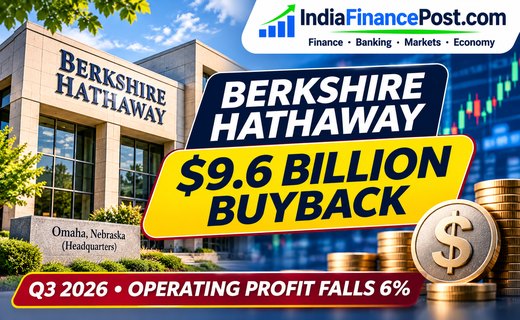
Berkshire Hathaway share buyback activity accelerated sharply in the third quarter of 2026, even as the American conglomerate reported weaker profits from its insurance operations.
The company repurchased approximately $9.6 billion of its own shares during July–September 2026, according to results released on November 7. Operating earnings declined nearly 6% year-on-year to $12.71 billion, while net earnings fell approximately 28% to $22.11 billion.
The contrasting developments highlight how Berkshire, now led by Chief Executive Greg Abel, is deploying substantial capital while navigating uneven performance across its businesses.
Berkshire Hathaway Share Buyback Reaches $9.6 Billion
Berkshire’s third-quarter repurchases lifted its total buybacks for the first nine months of 2026 to approximately $14.4 billion.
The company also repurchased about $2 billion of additional shares during the first four weeks of October, according to Reuters.
Share buybacks reduce the number of outstanding shares and can increase continuing shareholders’ proportional ownership. However, their financial value depends heavily on the price paid.
The increased activity suggests management sees opportunities to allocate capital through Berkshire’s own stock rather than relying exclusively on acquisitions or external investments.
It does not guarantee higher future share prices.
Berkshire Hathaway Q3 2026 Results: Key Numbers
Berkshire’s official November 7 earnings release reported the following figures:
| Financial metric | Q3 2026 | Q3 2025 |
|---|---|---|
| Operating earnings | $12.71 billion | $13.49 billion |
| Net earnings | $22.11 billion | $30.80 billion |
| Insurance underwriting earnings | $1.35 billion | $2.37 billion |
| BNSF railway earnings | $1.73 billion | $1.45 billion |
| Berkshire Hathaway Energy earnings | $1.61 billion | $1.49 billion |
The results show considerable variation across Berkshire’s operating businesses.
Importantly, Berkshire cautions investors against relying too heavily on quarterly net earnings because changes in the market value of its equity investments can create substantial accounting fluctuations.
Operating earnings provide an additional perspective on underlying business performance, although they do not capture every financial risk.
Why Did Berkshire Hathaway’s Profit Decline?
Weaker insurance performance was a major contributor to the decline in operating earnings.
Insurance underwriting earnings dropped from $2.37 billion to $1.35 billion. Geico, Berkshire’s major automobile insurer, faced pressure as it adjusted pricing to compete for customers.
Insurance investment income also declined compared with the previous year.
Other businesses performed more strongly. BNSF railway earnings increased approximately 19%, while Berkshire Hathaway Energy recorded growth of around 8%.
This diversification helped offset part of the insurance weakness but could not prevent the overall operating earnings decline.
What Does the Buyback Signal Under Greg Abel?
The repurchase programme is attracting attention because it comes during Greg Abel’s tenure as chief executive, following Warren Buffett’s long leadership of Berkshire Hathaway.
The larger buybacks suggest a willingness to return capital to shareholders when management considers Berkshire shares an attractive use of funds.
Nevertheless, Berkshire continues to maintain substantial financial resources for acquisitions, investments and unexpected obligations.
The buybacks should therefore be viewed as a capital-allocation decision rather than evidence that the company expects immediate earnings growth.
What Should Indian Investors Watch?
For Indian investors following US markets, Berkshire’s results offer useful lessons about evaluating diversified businesses.
A decline in reported net profit does not necessarily indicate that every operating division is weakening. Similarly, a major share buyback does not automatically make a stock undervalued.
Investors should examine operating cash generation, insurance profitability, investment valuations and the price at which shares are repurchased.
Those considering international investments must also account for currency movements, taxation and their overall portfolio exposure.
Conclusion
Berkshire Hathaway’s $9.6 billion third-quarter share buyback stands out against a nearly 6% decline in operating earnings.
The results reveal weaker insurance profitability alongside stronger railway and energy operations.
For investors, the central question is whether Berkshire can deploy its considerable financial resources effectively while maintaining the long-term discipline associated with its investment strategy.
Disclaimer: This article is for informational purposes only and does not constitute investment advice. International equity investments involve market, currency and regulatory risks.