
Fixed Deposit vs Savings Account: Which Is Better?
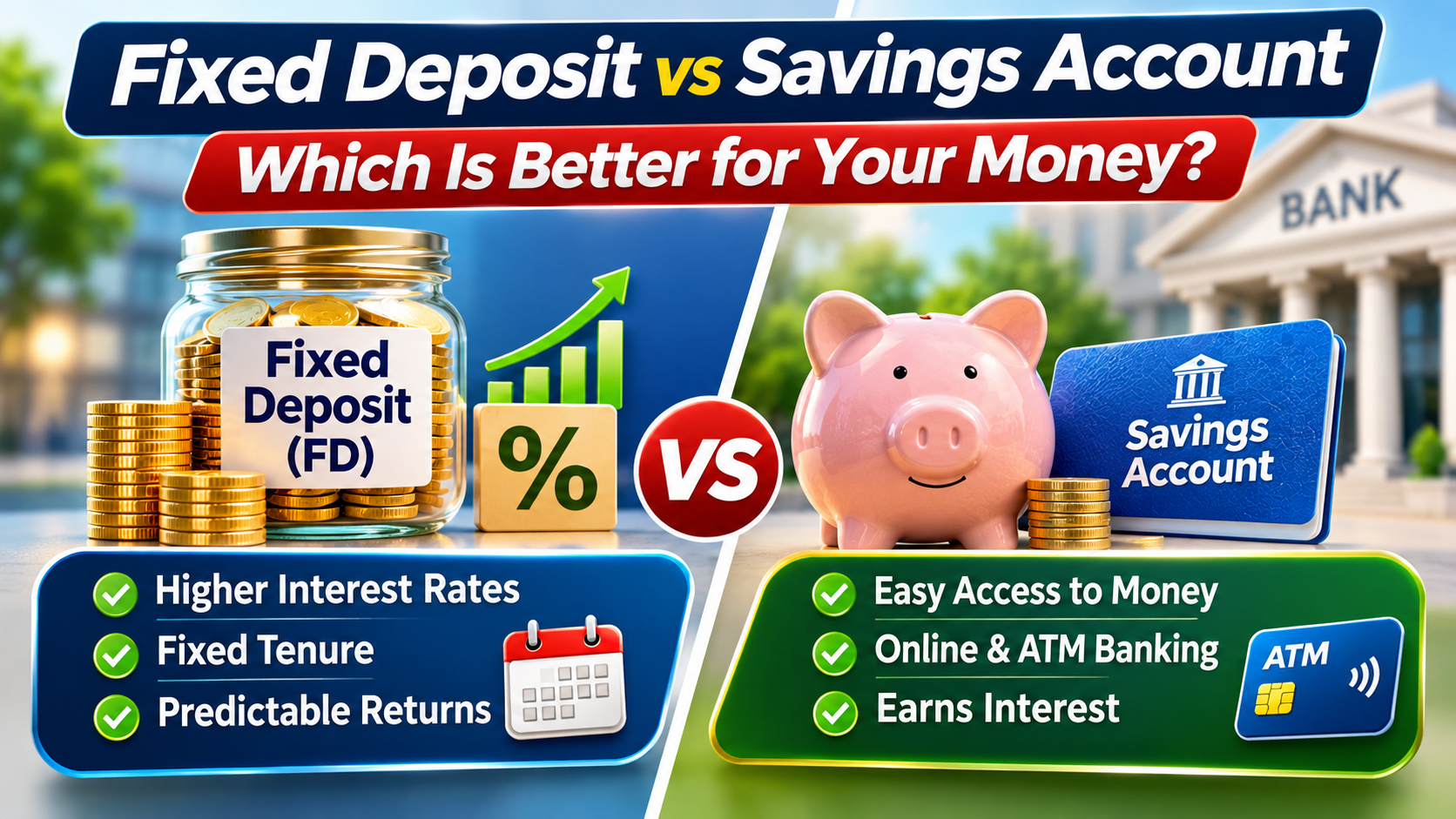
Fixed Deposit vs Savings Account: Which Is Better for Your Money?
Fixed Deposit vs Savings Account: Both are popular banking options in India, but they serve different purposes. A savings account helps you access money whenever needed, while a fixed deposit (FD) generally offers a fixed interest rate for a chosen period.
Understanding their differences can help you decide where to keep your emergency savings, short-term funds and money set aside for future goals.
What Is a Fixed Deposit?
A fixed deposit is a banking product in which you deposit a lump sum for a specified tenure at an agreed interest rate.
The deposit generally earns interest at that rate until maturity, provided the FD is held according to its terms.
Key Benefits of Fixed Deposits
- Predictable interest earnings
- Multiple tenure options
- Monthly, quarterly or cumulative interest options, depending on the bank
- Suitable for money that is not needed immediately
- Potentially higher interest rates than regular savings accounts
However, premature withdrawals may attract penalties, and some fixed deposits cannot be withdrawn early.
What Is a Savings Account?
A savings account is a bank account designed for everyday banking and keeping readily accessible funds.
Customers can generally deposit or withdraw money through online banking, ATMs and other available banking channels.
Key Benefits of Savings Accounts
- Convenient access to money
- Online payments and fund transfers
- ATM and debit card facilities, subject to account features
- Interest earnings on eligible balances
- Suitable for emergency funds and routine expenses
Interest rates and account charges vary between banks.
Fixed Deposit vs Savings Account: Key Differences
| Feature | Fixed Deposit | Savings Account |
|---|---|---|
| Interest rate | Usually fixed for the tenure | Generally variable |
| Access to money | Subject to FD withdrawal terms | Generally readily accessible |
| Tenure | Selected deposit period | No fixed maturity |
| Interest payout | Depends on FD option | Usually credited periodically |
| Best suited for | Planned savings | Emergency and everyday funds |
| Premature withdrawal penalty | May apply | Generally not applicable |
| Tax on interest | Generally taxable | Generally taxable, with eligible deductions |
Which Option Offers Better Interest?
Fixed deposits often offer higher interest rates than ordinary savings accounts. However, this is not guaranteed.
For example, consider a hypothetical investment of ₹1,00,000 for one year.
| Option | Assumed annual rate | Interest before tax |
|---|---|---|
| Fixed Deposit | 7% | ₹7,000 |
| Savings Account | 3% | ₹3,000 |
These figures are illustrations, not current bank offers. Actual earnings depend on interest calculations, compounding, rate changes and bank terms.
Are Fixed Deposits and Savings Accounts Safe?
Both products can qualify for deposit insurance when held with an eligible insured bank.
In India, the Deposit Insurance and Credit Guarantee Corporation (DICGC) provides insurance of up to ₹5 lakh per depositor per insured bank, covering eligible principal and interest together.
The limit applies to the combined eligible deposits of the depositor at the same bank, subject to applicable rules. It is not a separate ₹5 lakh limit for every FD or savings account.
How Are Interest Earnings Taxed?
Interest from fixed deposits is generally taxable according to the depositor’s applicable income-tax rules.
Savings account interest is also generally taxable, although eligible individuals may claim deductions under applicable provisions such as Section 80TTA or 80TTB, subject to the chosen tax regime and eligibility.
TDS may apply to bank interest when statutory conditions and thresholds are met.
Which Is Better for an Emergency Fund?
A savings account is generally more suitable for money you may need immediately.
A fixed deposit may be appropriate for a portion of emergency savings if the bank permits convenient premature withdrawal, although penalties and processing conditions should be checked.
Keeping some funds readily accessible can help avoid unnecessary borrowing during emergencies.
When Should You Choose a Fixed Deposit?
Consider a fixed deposit when:
- You have a lump sum that you can set aside.
- You want predictable interest earnings.
- You have a specific savings goal.
- You understand the withdrawal restrictions.
- You prefer relatively low-risk banking products over market-linked investments.
When Should You Choose a Savings Account?
Consider a savings account when:
- You need frequent access to funds.
- You are building an emergency reserve.
- You make regular payments or transfers.
- You want flexibility without a fixed deposit tenure.
Frequently Asked Questions
1. Is an FD better than a savings account?
An FD may offer better interest earnings, while a savings account generally provides easier access to money. The better choice depends on your needs.
2. Can I withdraw an FD before maturity?
Many banks permit premature withdrawal of eligible FDs, although penalties or reduced interest may apply.
3. Is FD interest tax-free?
Generally, no. FD interest is taxable under applicable income-tax rules.
4. Can I receive FD interest every month?
Many banks offer monthly interest payout options. The amount depends on the deposit terms and applicable interest rate.
5. Can I keep both an FD and a savings account?
Yes. Using both can help balance liquidity and predictable interest earnings.
Conclusion
Fixed deposits and savings accounts serve different financial purposes.
A savings account is useful for everyday banking and emergency funds, while a fixed deposit may be more suitable for planned savings that do not require immediate access.
Before selecting either option, compare the bank’s current interest rates, fees, withdrawal conditions and deposit insurance coverage.
Disclaimer: This article is for educational and informational purposes only and does not constitute personalised financial or investment advice. Interest rates, banking rules and tax provisions may change. Verify current terms with your bank and the relevant authorities.