VISTAR Scheme: Cabinet Approves ₹4,371 Crore Plan
VISTAR Scheme: Cabinet Approves ₹4,371 Crore Plan
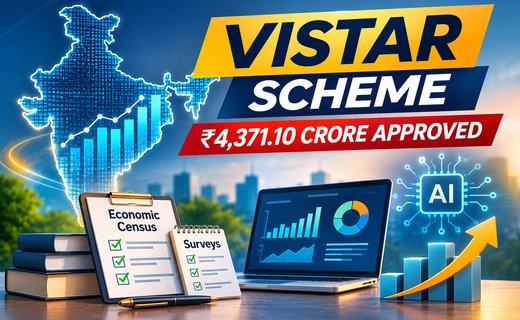
The VISTAR Scheme has received Union Cabinet approval with a financial outlay of ₹4,371.10 crore to modernise India’s official statistical system. Announced on 4 November 2026, the initiative aims to improve the availability, accuracy and usefulness of economic data for policymakers, businesses and researchers.
The scheme, formally called the Viksit Bharat Initiative for Statistical Transformation, Analytics & Research, will operate from FY 2026–27 to FY 2030–31.
It will support expanded surveys, digital data systems, state-level statistical capabilities and a new Economic Census.
VISTAR Scheme: Key Highlights
According to the official Cabinet announcement, the initiative will cover statistical and data-management activities of the Ministry of Statistics and Programme Implementation (MoSPI).
| Detail | Approved plan |
|---|---|
| Financial outlay | ₹4,371.10 crore |
| Implementation period | FY 2026–27 to FY 2030–31 |
| Proposed surveys | 59 |
| Major previous surveys cited | 43 |
| Economic Census | Eighth edition |
| Implementing ministry | MoSPI |
The government intends to build a more timely, detailed and interoperable statistical system.
Importantly, Cabinet approval does not mean every proposed survey or technology upgrade has already been implemented.
Three Major Components of the VISTAR Scheme
1. Comprehensive Statistical Operations
MoSPI proposes conducting 59 surveys during the 16th Finance Commission cycle, compared with 43 major surveys conducted previously.
The expanded programme is intended to address gaps in information about different parts of the economy.
The ministry also plans to digitise statistical processes and introduce artificial intelligence and machine learning for data processing, validation and analysis.
2. Support for Statistical Strengthening
The second component will support state and Union Territory governments in improving their statistical capabilities.
Under a redesigned framework, assistance will be linked to deliverables.
The government wants more detailed information at district and city levels, including estimates from major national surveys.
Better local statistics could help authorities identify economic differences between regions and design more targeted policies.
3. Eighth Economic Census
The third component covers the proposed eighth Economic Census.
It will collect information about non-farm establishments and their workers, extending to gram panchayat and ward levels.
The results are intended to improve understanding of India’s unorganised economy and support development of a National Statistical Business Register.
How Artificial Intelligence Could Improve Economic Data
A significant feature of the VISTAR Scheme is its emphasis on digital transformation.
MoSPI plans to use AI-assisted tools to check data quality, process information and support analysis.
The ministry also intends to explore alternative data sources, including mobile-phone, scanner and e-commerce information, to complement traditional surveys.
These methods could reduce reporting burdens and help identify economic trends more quickly.
However, their effectiveness will depend on data quality, privacy safeguards, consistent methodology and implementation.
Why Better Statistics Matter for Businesses and Investors
Official economic statistics influence decisions across government and the private sector.
Businesses use information about production, consumption and employment to assess demand and plan investments.
Investors monitor economic indicators to understand sector trends, inflation pressures and business conditions.
More detailed statistics could also help policymakers identify regions needing infrastructure, employment support or other interventions.
MoSPI plans to develop additional measures, including a Headline Index of Services Production and an Index of Unincorporated Sector Enterprises.
These indicators could eventually provide more insight into economic activities that are difficult to measure.
Frequently Asked Questions
Is the VISTAR Scheme approved?
Yes. The Union Cabinet approved the scheme on 4 November 2026.
What is the VISTAR Scheme budget?
The approved outlay is ₹4,371.10 crore for FY 2026–27 through FY 2030–31.
Will individuals receive money under VISTAR?
No direct household cash benefit was announced. The scheme focuses on improving India’s official statistical infrastructure.
Conclusion
The VISTAR Scheme represents a substantial investment in India’s economic information systems.
Its planned surveys, digital tools and Economic Census could improve the evidence available to governments, businesses and researchers.
The benefits will depend on effective implementation, transparent methodologies and the timely publication of reliable data.
Disclaimer: This article is for general information and does not constitute financial or investment advice.