India Energy Storage Scheme: ₹14,500 Crore Approved
India Energy Storage Scheme: ₹14,500 Crore Approved
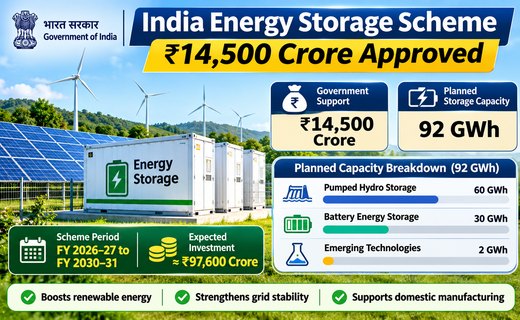
The India Energy Storage Scheme has received a major boost after the Union Cabinet approved ₹14,500 crore in financial support to develop 92 gigawatt-hours (GWh) of grid-scale energy storage capacity.
Announced on 4 November 2026, the initiative aims to improve electricity reliability, support renewable energy expansion and encourage domestic manufacturing.
The scheme will operate from FY 2026–27 to FY 2030–31, with total project investment estimated at approximately ₹97,600 crore.
India Energy Storage Scheme: Key Highlights
According to the Government of India’s official announcement, the Cabinet approved a Viability Gap Funding (VGF) scheme for grid-scale energy storage projects.
The financial assistance is intended to improve project viability and encourage investment in storage infrastructure.
| Scheme detail | Approved plan |
|---|---|
| Government financial support | ₹14,500 crore |
| Planned storage capacity | 92 GWh |
| Estimated total investment | ₹97,600 crore |
| Implementation period | FY 2026–27 to FY 2030–31 |
| Battery energy storage | 30 GWh |
| Pumped hydro storage | 60 GWh |
| Emerging storage technologies | 2 GWh |
The 92 GWh represents capacity targeted for development, not projects already commissioned.
How Will the ₹14,500 Crore Scheme Work?
The scheme will provide Viability Gap Funding to eligible energy storage projects.
VGF is government financial assistance designed to improve the commercial viability of infrastructure projects that may otherwise struggle to attract sufficient investment.
Under the approved framework, storage capacity will be allocated through tariff-based competitive bidding.
Public and private electricity distribution companies will be eligible for support involving battery energy storage and pumped hydro projects.
Alternative storage technology projects may be implemented by eligible public or private sector entities.
The government expects the assistance to accelerate investment while encouraging competition.
Why Does India Need More Energy Storage?
India is expanding electricity generation from renewable sources such as solar and wind.
However, solar panels generate electricity mainly during daylight hours, while wind generation varies with weather conditions.
Electricity demand does not always match renewable energy production.
Storage systems help address this challenge by retaining energy when generation is available and releasing it when required.
For example, electricity generated by solar projects during the afternoon can potentially be stored for use during evening demand.
Large-scale storage can also support grid stability and reduce the need for some conventional generation used to balance electricity supply.
Battery Storage and Pumped Hydro: What Is the Difference?
The scheme supports multiple technologies rather than relying on batteries alone.
Battery Energy Storage Systems (BESS) store electricity in rechargeable batteries and release it when needed.
These systems can respond quickly to changes in electricity demand and supply.
Pumped hydro storage uses electricity to pump water to a higher reservoir. When power is needed, the water flows downward through turbines to generate electricity.
The government has allocated the largest share of planned capacity, 60 GWh, to pumped hydro projects.
Another 2 GWh is intended for emerging storage technologies.
Major Push for Domestic Battery Manufacturing
The scheme also includes a requirement intended to strengthen Indian manufacturing.
Battery energy storage projects will be subject to a minimum 40% Domestic Content Requirement.
This provision is designed to encourage domestic production and reduce dependence on imported components.
It could create opportunities for Indian manufacturers, equipment suppliers and infrastructure companies.
However, the eventual business impact will depend on project awards, procurement decisions and implementation.
Will Electricity Bills Become Cheaper?
Consumers should not expect an immediate reduction in electricity bills simply because the scheme has been approved.
Energy storage can help improve electricity-system efficiency and reliability over time.
However, retail electricity tariffs depend on several factors, including generation costs, distribution expenses, state regulations and subsidy policies.
The scheme’s financial and operational benefits will become clearer as projects are awarded, constructed and commissioned.
Frequently Asked Questions
Is the India Energy Storage Scheme approved?
Yes. The Union Cabinet approved the ₹14,500 crore support scheme on 4 November 2026.
How much energy storage capacity is planned?
The scheme targets 92 GWh, including pumped hydro, battery storage and emerging technologies.
Can individuals apply for the scheme?
The announced framework is designed for eligible grid-scale energy storage projects and participating entities, not direct cash payments to individual households.
Conclusion
The India Energy Storage Scheme represents a significant government initiative to strengthen India’s electricity infrastructure.
With ₹14,500 crore in approved support and approximately ₹97,600 crore in expected investment, the scheme could accelerate renewable energy integration and domestic manufacturing.
Its long-term success will depend on competitive project allocation, timely construction and reliable operation.
Disclaimer: This article provides general information and is not investment advice.