RBI Liquidity Move: ₹50,000 Crore Auction Sees Big Bids
RBI Liquidity Move: ₹50,000 Crore Auction Sees Big Bids
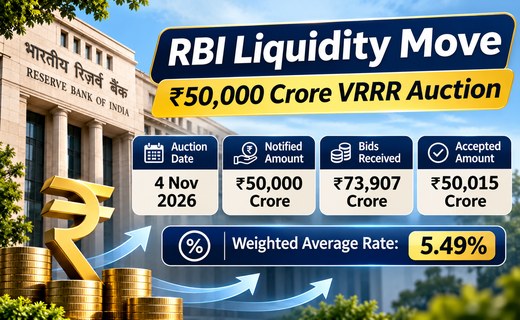
The latest RBI Liquidity Move has drawn attention after banks submitted offers worth ₹73,907 crore in a ₹50,000 crore variable rate reverse repo (VRRR) auction held on November 4, 2026.
According to the Reserve Bank of India’s auction results, the central bank accepted ₹50,015 crore at a weighted average rate of 5.49%.
The strong response marked a sharp improvement from November 3, when banks had offered only ₹23,905 crore against a similar ₹50,000 crore operation.
The figures provide an important picture of how banks are managing short-term surplus funds.
RBI Liquidity Move: Latest Auction Results
The RBI conducted the November 4 auction under its Liquidity Adjustment Facility to temporarily absorb surplus money from the banking system.
The official results reported the following figures:
| Auction detail | November 4, 2026 |
|---|---|
| Notified amount | ₹50,000 crore |
| Total offers received | ₹73,907 crore |
| Amount accepted | ₹50,015 crore |
| Auction tenor | 1 day |
| Cut-off interest rate | 5.49% |
| Weighted average rate | 5.49% |
Banks submitted offers equivalent to approximately 147.8% of the notified amount.
The RBI’s reported accepted amount was ₹15 crore above the notified figure.
These are money-market auction figures, not amounts distributed to ordinary bank customers.
The RBI’s official auction result provides the detailed outcome.
What Is a VRRR Auction?
A variable rate reverse repo auction is a tool used by the RBI to absorb excess liquidity from banks for a specified period.
Participating banks place surplus funds with the central bank and earn interest determined through the auction process.
When the operation matures, the funds return to participating banks according to the applicable terms.
This mechanism helps the RBI manage short-term liquidity and maintain orderly money-market conditions.
Importantly, a VRRR auction is different from a change in the RBI’s policy repo rate.
Why Did Bank Participation Increase?
The November 3 auction attracted bids worth ₹23,905 crore, representing approximately 47.8% of the ₹50,000 crore offered.
On November 4, bids rose to ₹73,907 crore, more than three times the previous day’s amount.
This shows that participating banks were more willing or able to place surplus funds with the RBI during the later operation.
However, the auction results alone do not establish the precise reason for the increase.
Liquidity can be unevenly distributed across banks, and institutions may have different funding needs on different days.
RBI Announces Another Liquidity Operation
The RBI also conducted a second overnight VRRR auction on November 4.
That separate operation had a notified amount of ₹25,000 crore.
It received offers worth ₹1,180 crore, all of which were accepted at a weighted average rate of 5.49%.
The second auction demonstrates why each liquidity operation should be assessed separately rather than combining notified amounts with actual funds absorbed.
What Does This Mean for Banks?
For banks, temporary liquidity absorption can influence the availability and pricing of overnight funds.
VRRR participation also provides information about institutions’ willingness to park surplus money with the central bank.
These operations are part of routine liquidity management and do not necessarily indicate an immediate change in broader monetary policy.
The RBI’s official website publishes liquidity operations and money-market data for further reference.
Will FD Rates or Loan EMIs Change?
Ordinary depositors and borrowers should not assume that this auction will directly change fixed deposit interest rates or loan EMIs.
Retail lending and deposit rates depend on several factors, including bank funding costs, competition, contractual terms and monetary policy.
A short-term VRRR auction primarily affects banking-system liquidity and money-market conditions.
Any eventual impact on retail products would be indirect and cannot be determined from this auction alone.
Frequently Asked Questions
Did the RBI cut interest rates?
No. The November 4 VRRR operation was a liquidity-management auction, not a policy repo-rate announcement.
Did banks bid more than ₹50,000 crore?
Yes. Banks offered ₹73,907 crore against the notified ₹50,000 crore amount.
Does this mean banks are facing a crisis?
No such conclusion can be drawn from these auction results. VRRR operations are standard tools for managing short-term liquidity.
Conclusion
The RBI Liquidity Move on November 4, 2026, recorded substantially stronger participation than the previous day’s operation.
Banks offered ₹73,907 crore in the main auction, while the RBI accepted ₹50,015 crore at 5.49%.
The results highlight changing short-term liquidity conditions, but they do not automatically signal changes in loan rates, deposit returns or the RBI’s monetary policy stance.
Disclaimer: This article is for general financial information and does not constitute investment advice.