
LIC Q2 Results 2026: Profit Surges 20%
LIC Q2 Results 2026: Profit Surges 20%
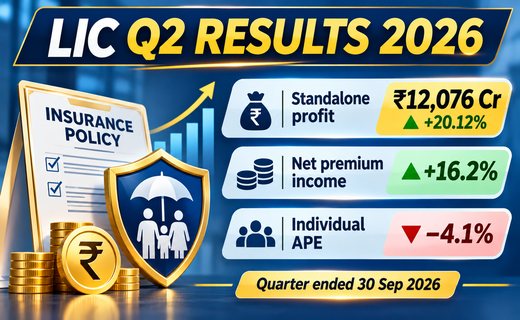
LIC Q2 Results 2026 show a strong rise in profitability even as growth in individual insurance sales weakened. Life Insurance Corporation of India reported standalone net profit of ₹12,076 crore for the July–September quarter of FY2026–27, an increase of 20.12% from ₹10,053 crore a year earlier.
Net premium income increased approximately 16.2% to ₹1.47 lakh crore. However, slower demand for individual policies, particularly market-linked insurance products, highlighted changing preferences among customers.
LIC announced the results on 5 November 2026.
LIC Q2 Results 2026: Key Financial Numbers
The insurer’s earnings reflected stronger premium collections and improving profitability from new business.
| Indicator | Q2 FY27 performance |
|---|---|
| Standalone net profit | ₹12,076 crore |
| Net premium income | Approximately ₹1.47 lakh crore |
| Overall annualised premium equivalent (APE) | ₹17,004 crore |
| Value of new business (VNB) | ₹3,710 crore |
| Net VNB margin | 21.82% |
| Corrected assets under management | ₹59,60,941 crore |
Overall APE, a standardised measure of new insurance business, grew 3.8% year-on-year.
Meanwhile, VNB increased 17.14%, and the net VNB margin improved from 19.33% to 21.82%.
This indicates that LIC generated greater estimated value from its new business despite relatively modest overall APE growth.
The company’s official quarterly financial results provide the underlying disclosures.
Group Insurance Grows as Individual Sales Slow
The most important development was the difference between group and individual insurance demand.
According to reporting on the results, group business APE increased approximately 16.5% year-on-year, while individual business APE declined about 4.1%.
Group insurance typically covers employees or members through arrangements made by employers or organisations.
Individual policies, by contrast, are purchased directly by customers for personal protection or savings needs.
The divergence suggests that institutional insurance demand was more resilient during the quarter than retail new-business sales.
However, lower individual APE does not automatically indicate that existing policyholders are discontinuing their policies. New-business sales and policy persistency measure different aspects of insurance operations.
Why LIC Is Shifting Attention Towards Term Insurance
LIC management indicated that weaker equity-market sentiment affected demand for unit-linked insurance plans, commonly known as ULIPs.
ULIPs combine life insurance protection with investments linked to market performance. Their investment value can fluctuate, making them sensitive to investor confidence.
LIC is consequently placing greater emphasis on pure-term protection, conventional savings products and annuities.
The insurer introduced a new term insurance product in September and reported selling more than 58,000 policies under that product during the final days of the month.
This strategic shift matters because term insurance serves a different purpose from market-linked savings policies.
What Policyholders Should Understand
LIC’s quarterly profit growth does not mean every insurance policy will deliver higher returns or benefits.
Customers should evaluate products according to their own requirements.
Term insurance: Primarily provides financial protection to dependants. It generally does not offer investment-linked maturity proceeds.
Traditional savings policies: Combine insurance coverage with savings features, subject to the policy’s stated benefits, costs and conditions.
ULIPs: Combine insurance and market-linked investments. Returns are not guaranteed, and charges, fund performance and risk exposure require careful examination.
Consumers should compare premiums, exclusions, surrender conditions and policy illustrations before committing to a long-term contract.
Existing policyholders do not need to change their coverage merely because the insurer has announced quarterly earnings.
LIC Corrects Its Assets Under Management Figure
LIC issued a corrigendum on 5 November concerning its reported assets under management.
The corrected figure was ₹59,60,941 crore as of 30 September 2026.
This represents approximately 4.16% growth from the corresponding period a year earlier.
The correction is important because AUM is a measure of assets managed by the insurer, not the amount of profit earned during the quarter.
Investors and readers should rely on the corrected disclosure rather than an earlier version of the press release.
The relevant announcement is available through LIC’s official investor disclosures.
The Choice Facing Insurance Buyers
LIC’s latest results reveal two developments: improving new-business profitability and a greater emphasis on protection products as market-linked insurance demand slows.
For insurance buyers, the practical question is not which product LIC is currently promoting. It is whether a policy offers suitable protection, affordable premiums and terms that match their financial goals.
That distinction remains more important than any single quarter’s earnings performance.
Disclaimer: This article is for informational purposes only and does not constitute investment or insurance advice. Policy terms, charges, exclusions and risks should be reviewed before purchase.