
RBI Liquidity Auction November 2026: ₹25,000 Cr
RBI Liquidity Auction November 2026: ₹25,000 Cr
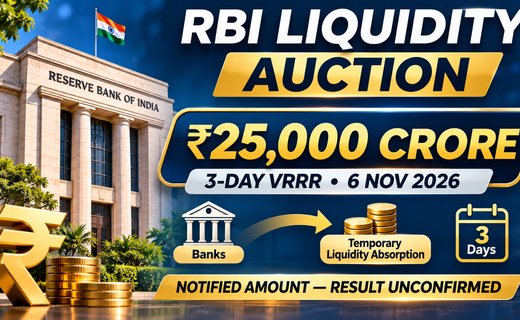
RBI Liquidity Auction November 2026 is the latest step in the Reserve Bank of India’s efforts to manage short-term liquidity in India’s banking system. The central bank announced on 5 November that it would conduct a three-day variable rate reverse repo (VRRR) auction for a notified amount of ₹25,000 crore on Friday, 6 November 2026.
The operation is intended to temporarily absorb surplus funds from eligible banking participants. However, the notified amount does not mean the RBI will necessarily absorb the entire ₹25,000 crore.
The actual amount depends on bids received and accepted at the auction.
RBI Liquidity Auction November 2026: Key Details
The RBI scheduled the auction after reviewing current and evolving liquidity conditions.
| Particular | Details |
|---|---|
| Auction type | Variable Rate Reverse Repo |
| Notified amount | ₹25,000 crore |
| Auction date | 6 November 2026 |
| Bidding window | 9:30 AM–10:00 AM IST |
| Tenor | Three days |
| Reversal date | 9 November 2026 |
The auction falls under the RBI’s Liquidity Adjustment Facility (LAF), which helps regulate short-term liquidity and money-market conditions.
The announcement follows the operational framework described in the RBI’s earlier VRRR auction guidelines.
How Does a Reverse Repo Auction Work?
A variable rate reverse repo auction allows eligible financial institutions to place surplus funds with the RBI for a specified period.
Participants submit bids indicating the amount they wish to place and the interest rate they seek.
The RBI evaluates those bids and determines the accepted amount and applicable auction rate according to its operating framework.
During the three-day period, accepted funds are temporarily withdrawn from the banking system. They return when the transaction reverses on 9 November.
Unlike a fixed-rate arrangement, the rate in a VRRR auction is determined through competitive bidding.
This gives the central bank an additional mechanism to manage liquidity without changing its main policy interest rate.
Why Is the RBI Absorbing Liquidity?
Liquidity conditions can fluctuate because of government transactions, currency movements, tax payments and other banking-system cash flows.
When banks collectively hold excess short-term funds, money-market rates may face downward pressure.
A reverse repo auction provides an avenue for temporarily parking that surplus with the central bank.
The RBI’s decision to schedule this operation indicates that it considered temporary liquidity absorption appropriate under prevailing conditions.
It should not automatically be interpreted as a change in the monetary policy stance or a signal that the repo rate will move.
What Earlier Auction Results Show
Recent auctions demonstrate why the announced amount and actual absorption must be distinguished.
In the separate overnight VRRR auction held on 5 November, the RBI notified ₹75,000 crore but received and accepted bids totalling ₹7,767 crore.
The cut-off and weighted average rates were both 5.49%.
Those figures relate exclusively to the 5 November operation, not the new three-day auction.
The RBI’s official auction-result release provides the relevant figures.
The result of the 6 November auction requires separate confirmation before its accepted amount or rate can be reported.
Will Bank Customers or Borrowers Be Affected?
The immediate effects are concentrated in interbank liquidity management and short-term funding markets.
For ordinary savings account holders and fixed deposit customers, this operation does not directly change the interest rate offered by their bank.
Similarly, borrowers should not assume that lending rates will change because of one reverse repo auction.
Bank deposit and loan pricing depends on several factors, including monetary policy, funding costs, competition and individual bank decisions.
A temporary liquidity operation may influence money-market conditions, but its impact on retail financial products is indirect.
The Number That Matters Next
The key development to monitor is the RBI’s published auction result.
Three figures will reveal how the operation performed: the total bids received, the amount accepted and the weighted average interest rate.
Together, they will show how much liquidity was actually absorbed and at what cost.
Until those figures are confirmed, ₹25,000 crore should be described strictly as the notified auction amount, not completed liquidity absorption.
Disclaimer: This article is for general financial information and does not constitute investment or banking advice.