India October Inflation 2026: CPI May Hit 5.93%
India October Inflation 2026: CPI May Hit 5.93%
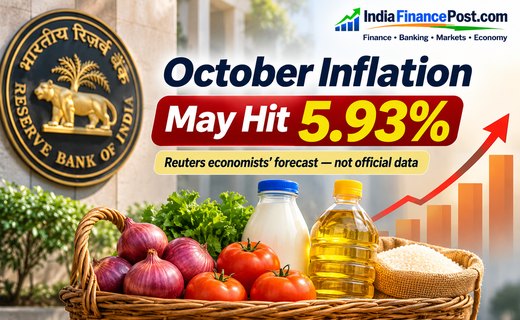
India October Inflation 2026 could climb to 5.93%, bringing retail price growth close to the Reserve Bank of India’s upper tolerance limit of 6%, according to a new Reuters survey of economists.
The forecast, published on November 6, reflects mounting pressure from food prices, including vegetables, milk, edible oils and other household essentials. India’s official October Consumer Price Index (CPI) data is scheduled for release on November 12.
For households already dealing with expensive groceries, the findings raise concerns about purchasing power and the possibility of further interest rate increases.
India October Inflation 2026: Key Forecasts
A Reuters survey conducted from November 2 to 6 gathered projections from 36 economists.
The median estimate suggests annual retail inflation increased from September’s 5.54% to 5.93% in October.
| Inflation indicator | September actual | October forecast |
|---|---|---|
| Retail CPI inflation | 5.54% | 5.93% |
| Food inflation | 7.74% | 8.20% |
| Core inflation | — | 4.45% |
The October numbers are estimates, not government-confirmed results. Economists’ headline inflation forecasts ranged from 5.50% to 6.60%.
Nearly half the respondents expected inflation to reach or exceed 6%, the upper boundary of the RBI’s tolerance range.
Why Are Food Prices Rising?
Food prices account for a substantial share of India’s consumer inflation basket, making changes in grocery costs particularly important.
An uneven and deficient monsoon has affected agricultural supplies in several regions, contributing to higher prices for vegetables and other essentials.
Reuters reported that onion prices had nearly doubled since the beginning of 2026. Milk, eggs, meat and edible oils have also become more expensive.
Higher international commodity prices have added pressure, especially on imported edible oils.
The survey projects food inflation rising to 8.20% in October, compared with 7.74% in September.
Persistent food inflation can hurt lower-income households disproportionately because groceries consume a larger share of their monthly spending.
What Do September’s Official CPI Figures Show?
India’s retail inflation reached 5.54% in September, according to the Ministry of Statistics and Programme Implementation’s official statistics portal.
That was above the RBI’s medium-term inflation target of 4%.
September’s increase was driven significantly by food costs, with pressure extending beyond a single commodity.
The latest survey indicates that economists expect this trend to continue into October.
However, the actual October figure could differ from the poll’s median estimate because inflation data reflects prices collected across numerous markets and consumption categories.
Could the RBI Raise Interest Rates Again?
The inflation outlook has implications for monetary policy.
The RBI increased its benchmark repo rate by 25 basis points to 5.50% in October 2026, responding to persistent price pressures.
The central bank also raised its inflation projection for financial year 2026–27 to 5.2%.
Economists surveyed previously by Reuters expect another possible rate increase in December, potentially taking the repo rate to 5.75%.
That remains a forecast rather than an announced RBI decision.
Any future move will depend on incoming inflation data, economic growth, currency conditions and the central bank’s assessment of risks.
What Could Higher Inflation Mean for Your Budget?
Higher food inflation directly reduces household purchasing power.
Families may need to allocate more money to groceries, leaving less available for savings, discretionary purchases and investments.
Borrowers should also monitor monetary policy. If the RBI raises the repo rate, lenders may increase interest rates on some floating-rate loans, depending on their benchmark and reset terms.
Existing fixed-rate loans generally do not change automatically following a repo-rate increase.
For savers, higher deposit rates may eventually improve interest income, although banks determine their own pricing and adjustments can take time.
A practical response is to review recurring expenses, maintain an emergency fund and avoid making financial decisions based solely on inflation forecasts.
When Will October CPI Data Be Released?
The official October inflation report is scheduled for November 12, 2026.
The government’s CPI release guidance states that monthly figures are normally published on the 12th at 5:30 PM, or the next working day when applicable.
Investors and households should watch whether headline inflation remains below 6%, how food prices behave and whether underlying price pressures broaden.
The Reuters poll provides an early warning about rising costs, but the official data will determine how closely those expectations match reality.
Disclaimer: This article is for general information only. Inflation forecasts and interest rate expectations are uncertain and should not be treated as financial advice.