
How to Get a Business Loan Without Collateral
How to Get a Business Loan Without Collateral
How to Get a Business Loan Without Collateral is an important question for Indian entrepreneurs who need financing but cannot pledge property or other assets as security.
Collateral-free loans can help eligible businesses purchase equipment, manage working capital or expand operations. However, lenders still assess creditworthiness, cash flow and repayment capacity.
Understanding the available financing routes can help entrepreneurs apply more confidently.
What Is a Collateral-Free Business Loan?
A collateral-free business loan does not require the borrower to pledge additional assets such as land or property as security.
This differs from a secured loan, where specified assets support the borrowing.
Collateral-free does not mean interest-free, risk-free or automatically approved. Lenders may still require documentation, guarantees permitted under the relevant product, or primary security over assets financed.
RBI Rules for Collateral-Free MSME Loans
The Reserve Bank of India requires banks to dispense with collateral security for eligible micro and small enterprise loans up to ₹20 lakh.
This revised limit applies to loans sanctioned or renewed on or after April 1, 2026.
Banks may extend collateral-free lending up to ₹25 lakh for eligible enterprises with a satisfactory track record and financial position, subject to their internal policies.
These provisions concern qualifying micro and small enterprises; they do not mean every business can automatically borrow ₹20 lakh.
Business Loan Options Without Collateral
| Financing option | Key feature |
|---|---|
| Bank MSME loan | Eligible micro and small enterprises benefit from RBI collateral rules |
| CGTMSE-backed loan | Participating lenders can obtain credit guarantee support |
| Mudra loan | Financing for eligible micro-enterprises under PMMY |
| Unsecured NBFC loan | Approval depends on lender policies and business creditworthiness |
How CGTMSE Works
The Credit Guarantee Fund Trust for Micro and Small Enterprises (CGTMSE) supports eligible collateral-free lending through member lending institutions.
The guarantee protects the lender against a specified portion of eligible credit losses. It is not a direct government loan or a guarantee that the borrower’s application will be approved.
Borrowers should ask their lender whether the proposed facility qualifies for CGTMSE coverage and whether guarantee-related charges apply.
How to Get a Business Loan Without Collateral: Step-by-Step Process
Step 1: Calculate Your Funding Requirement
Estimate how much money is required for inventory, equipment, business expansion or day-to-day operations.
Prepare a realistic repayment plan based on expected business cash flow.
Step 2: Check Your Business Eligibility
Confirm your enterprise’s legal structure, business activity and MSME classification.
Lenders may examine operating history, turnover, existing liabilities and credit reports.
A new business may face different documentation and assessment requirements from an established enterprise.
Step 3: Compare Banks and NBFCs
Approach authorised lenders and compare their eligibility requirements.
Ask whether the facility is collateral-free, whether CGTMSE coverage is available and what fees or guarantees may apply.
Compare the total borrowing cost rather than only the advertised interest rate.
Step 4: Prepare the Required Documents
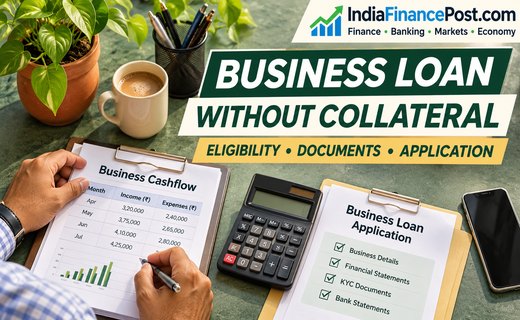
Depending on the lender, applicants may need:
- PAN and identity documents.
- Business registration or Udyam details, where applicable.
- Recent bank statements.
- GST returns and income-tax records, where applicable.
- Financial statements or turnover information.
- A business plan and projected cash flow.
The exact checklist varies by lender and loan product.
Step 5: Submit Your Application
Apply through the lender’s official website or branch.
Provide accurate information about your business, funding purpose and existing borrowings.
Keep the application acknowledgement for follow-up.
Step 6: Review the Sanction Terms
If approved, examine the interest rate, processing fees, repayment schedule, default charges and security conditions.
Ensure the proposed instalments are affordable before accepting the loan.
Why Collateral-Free Business Loans Get Rejected
Common reasons include weak cash flow, excessive existing debt, incomplete documents and an unsuitable business proposal.
A poor credit history may also affect approval.
Improve your application by maintaining accurate financial records and requesting an amount supported by realistic business income.
For a scheme-specific option, eligible entrepreneurs can also explore the Pradhan Mantri MUDRA Yojana.
Conclusion
Collateral-free business finance can help eligible entrepreneurs access credit without pledging additional property.
The best approach is to understand RBI protections, compare suitable lenders, prepare reliable financial records and assess repayment affordability.
How to Get a Business Loan Without Collateral ultimately depends on matching your business requirements with a suitable credit product and demonstrating repayment capacity.
Disclaimer: This article is for general educational purposes and is not personalised financial advice. Loan eligibility, interest rates, charges and credit guarantee conditions depend on applicable rules and lender policies.