
Nifty 50 vs Sensex: What Is the Difference?
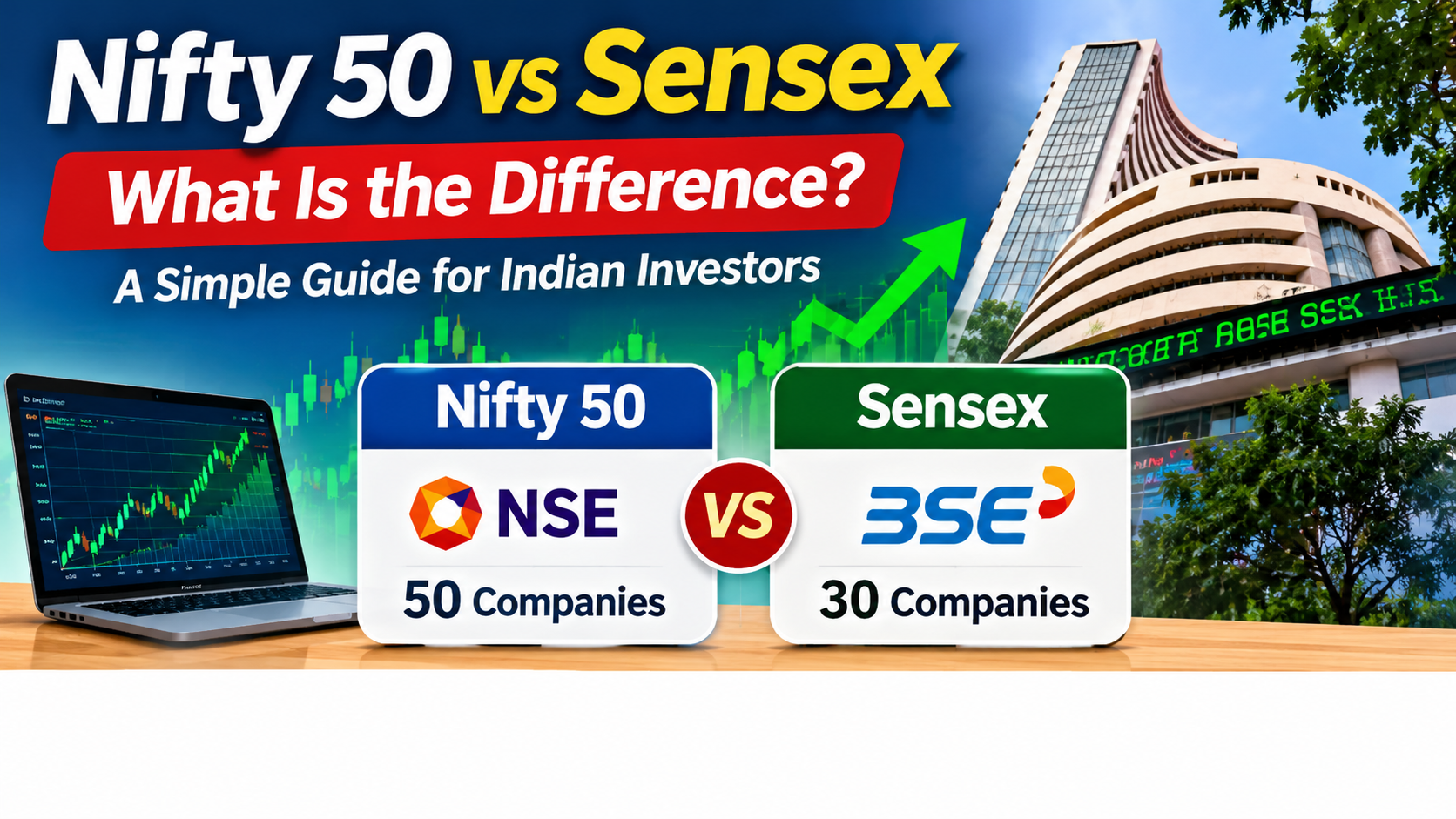
Nifty 50 vs Sensex: Both are major Indian stock market indices, but they differ in the number of companies, stock exchanges and index composition.
Introduction
Nifty 50 and Sensex are two of the most widely followed stock market indices in India. Whenever financial news reports that the Indian stock market has risen or fallen, these two indices are frequently mentioned.
Although both represent the performance of major Indian companies, they are not identical. They differ in the number of companies included, the stock exchanges associated with them, and their selection methodologies.
Understanding these differences can help new investors follow market news, compare investments, and make better-informed financial decisions.
What Is Nifty 50?
The Nifty 50 is a benchmark stock market index associated with the National Stock Exchange (NSE) of India.
It represents 50 major companies selected from different sectors of the Indian economy, including banking, information technology, automobiles, pharmaceuticals, and consumer goods.
The index is calculated using a free-float market-capitalisation-weighted methodology. This means companies with higher eligible market capitalisation generally have a greater influence on index movements.
Investors frequently use Nifty 50 to understand overall market trends and evaluate the performance of large-cap equity investments.
What Is Sensex?
Sensex, officially known as the S&P BSE SENSEX, is the benchmark index of BSE, formerly known as the Bombay Stock Exchange.
It tracks 30 established companies representing important sectors of the Indian economy.
Like Nifty 50, Sensex uses a free-float market-capitalisation-weighted methodology.
Sensex is one of India’s oldest and most recognised stock market benchmarks. It is frequently referenced in financial news to explain changes in investor sentiment and market performance.
Nifty 50 vs Sensex: Key Differences
| Feature | Nifty 50 | Sensex |
|---|---|---|
| Associated exchange | NSE | BSE |
| Number of companies | 50 | 30 |
| Launch year | 1996 | 1986 |
| Base year | 1995 | 1978–79 |
| Base value | 1,000 | 100 |
| Calculation | Free-float market-cap weighted | Free-float market-cap weighted |
| Coverage | 50 selected large companies | 30 selected large companies |
Both indices provide a useful picture of India’s large-company stock market, although their composition and weighting differ.
How Do Nifty 50 and Sensex Move?
Both indices change according to the market prices of their constituent companies and the weight assigned to each company.
For example, if heavily weighted banking and technology stocks rise, they may push an index higher even when some other companies decline.
Similarly, a sharp fall in major constituent stocks can pull an index downward.
An important point for beginners is that a rising Nifty 50 or Sensex does not mean every listed company is performing well.
Market movements may be influenced by corporate earnings, interest rates, inflation, foreign investment flows, government policies, and international economic developments.
Why Are These Indices Important for Investors?
1. Understanding Market Direction
Nifty 50 and Sensex help investors monitor the general performance of India’s large listed companies.
2. Comparing Investment Performance
Investors can compare the returns of equity mutual funds and portfolios against suitable market benchmarks.
3. Tracking Economic Developments
Changes in interest rates, corporate profitability, and investor expectations may influence both indices.
4. Investing Through Index Funds
Index mutual funds and exchange-traded funds (ETFs) allow investors to gain exposure to portfolios designed to track an index.
However, these investments carry market risk and do not guarantee returns.
Which Is Better: Nifty 50 or Sensex?
Neither index is automatically better for every investor.
Nifty 50 includes more companies, while Sensex focuses on a smaller group of established businesses. Both provide exposure to important sectors of the Indian economy.
The appropriate benchmark depends on an investor’s objectives, investment strategy, risk tolerance, and the products available.
Before investing, individuals should examine expenses, tracking differences, diversification, and long-term financial goals.
Frequently Asked Questions (FAQs)
Is Nifty 50 the Same as Sensex?
No. Nifty 50 tracks 50 selected companies, while Sensex tracks 30 selected companies.
Can Beginners Invest in Nifty 50 or Sensex?
Investors cannot directly purchase an index itself, but they can invest in mutual funds or ETFs designed to track it.
Does a Rising Sensex Mean All Stocks Are Rising?
No. An index can rise even when several constituent companies decline because companies have different index weights.
Are Nifty 50 and Sensex Investments Risk-Free?
No. Investments tracking either index are exposed to stock market fluctuations and possible losses.
Conclusion
Nifty 50 and Sensex are important benchmarks for understanding India’s stock market.
While Nifty 50 tracks 50 companies and Sensex tracks 30, both reflect the weighted performance of selected large businesses.
For beginners, learning how these indices work is a useful first step toward understanding financial markets and making informed investment decisions.
Disclaimer: This article is for educational purposes only and does not constitute investment advice.