
E20 Petrol Quality Test: 893 Samples Meet Standards
E20 Petrol Quality Test: 893 Samples Meet Standards
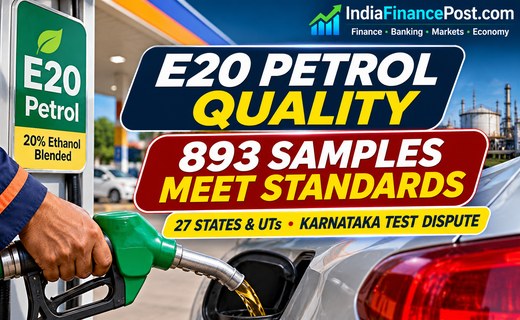
E20 Petrol Quality Test results released by the Union Ministry of Petroleum and Natural Gas show that all 893 samples examined in a national monitoring exercise met prescribed ethanol-blending specifications.
The ministry’s November 7, 2026, announcement comes amid disagreement with the Karnataka government over allegations that petrol at certain retail outlets contained excessive ethanol.
While the Centre’s findings provide evidence of compliance among the samples it tested, they do not independently resolve the conflicting results reported by Karnataka.
E20 Petrol Quality Test: What Did the Government Find?
According to the Petroleum Ministry’s official announcement, the Centre for High Technology and public-sector oil marketing companies examined 893 samples from depots and retail outlets across 27 states and Union Territories.
The samples were tested for ethanol content under IS 17021, Annex C, using refinery and oil-company quality-control laboratories.
| Oil marketing company | Samples tested |
|---|---|
| Indian Oil Corporation | 330 |
| Bharat Petroleum Corporation | 280 |
| Hindustan Petroleum Corporation | 283 |
| Total | 893 |
All 893 samples contained ethanol within the prescribed 19–21% range.
The results concern the samples collected and tested under this exercise. They should not be interpreted as proof that every petrol outlet in India has been individually tested.
Why Did Karnataka Raise Concerns?
Karnataka’s Department of Food, Civil Supplies, Consumer Affairs and Legal Metrology reported that petrol collected from certain outlets contained ethanol levels between 26% and 31%.
These findings prompted questions about whether some retailers were supplying fuel above the prescribed E20 blending range.
The three public-sector oil companies disputed the reported results, arguing that the October sampling and laboratory procedures did not provide sufficient information for independent verification.
The disagreement therefore concerns both the reported ethanol levels and the methods used to establish them.
What Did Tests in Karnataka Show?
The Centre said 56 samples collected from different Karnataka locations and across all three public-sector oil companies complied with the prescribed specifications.
Their ethanol content ranged from 19% to 20%, averaging 19.30%.
However, the companies’ samples and those examined during Karnataka’s separate exercise should not automatically be treated as identical.
A conclusive comparison requires clarity about sampling locations, collection dates, retained samples and laboratory methods.
The oil companies have requested joint sampling and independent testing to address the differences.
Why Is the Testing Method Important?
E20 petrol contains approximately 20% ethanol blended with petrol. Under the applicable specification, the permitted ethanol-content range is 19–21%.
The government’s clarification refers to prescribed sampling and testing procedures, including documentation, sample retention and authorised laboratory methods.
The oil companies questioned whether Karnataka’s laboratory certificates adequately documented the testing method, sample dilution and reference materials.
Those are technical matters that can affect whether results from different laboratories are directly comparable.
An independently verifiable exercise would help establish whether the conflicting findings reflect testing differences, fuel variation or another cause.
What Does This Mean for Vehicle Owners?
For motorists, the announcement offers reassurance about the fuel samples covered by the Centre’s monitoring exercise.
However, ethanol-content compliance and vehicle compatibility are separate questions.
A fuel sample meeting the prescribed blending standard does not, by itself, establish how every vehicle model will perform when using E20 petrol.
Vehicle age, manufacturer specifications, engine calibration and maintenance can influence the ownership experience.
Drivers should consult their vehicle manufacturer’s guidance on compatible fuel and seek authorised servicing if they notice persistent performance problems.
Why Does E20 Matter for India’s Economy?
India’s ethanol-blending programme aims to reduce dependence on imported petroleum while creating demand for domestically produced ethanol.
The programme also connects fuel policy with agricultural supply chains and the broader objective of diversifying transport fuels.
However, achieving blending targets must be accompanied by reliable quality monitoring and transparent communication with consumers.
The present disagreement demonstrates why consistent testing standards and accessible evidence matter as ethanol-blended petrol becomes increasingly common.
Conclusion
The Centre’s latest monitoring results found all 893 tested E20 petrol samples compliant with the prescribed ethanol-content range, including 56 samples from Karnataka.
Nevertheless, Karnataka’s separate allegations remain disputed, and joint verification would provide greater clarity.
For consumers, the key distinction is between confirmed compliance in tested samples, unresolved allegations at particular outlets and broader questions about vehicle compatibility.
Disclaimer: This article is for general information only. Vehicle owners should follow manufacturer guidance and consult qualified service professionals regarding fuel compatibility or performance concerns.