
US Inflation October 2026: CPI Rises 0.4%
US Inflation October 2026: CPI Rises 0.4%
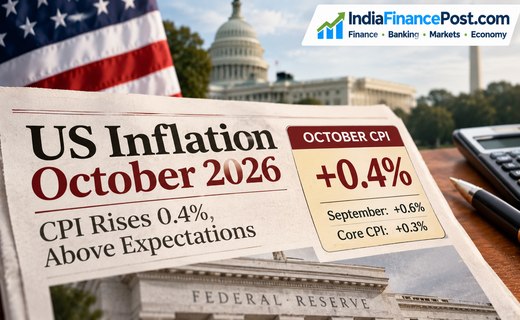
US Inflation October 2026 increased by 0.4% month-on-month, according to data released by the US Bureau of Labor Statistics (BLS) on 10 November 2026. Although price growth slowed from September’s 0.6%, the reading exceeded economists’ expectations of 0.3%.
The higher-than-expected figure has strengthened expectations that the US Federal Reserve could raise interest rates again. For Indian investors, the development matters because US monetary policy influences the dollar, global capital flows and financial markets.
US Inflation October 2026: Key CPI Figures
The Consumer Price Index (CPI) measures changes in prices paid by US consumers for everyday goods and services.
| Indicator | October 2026 | September 2026 |
|---|---|---|
| Headline CPI, monthly | 0.4% | 0.6% |
| Core CPI, monthly | 0.3% | 0.3% |
| Food prices, monthly | 0.5% | 0.0% |
| Energy prices, monthly | 0.7% | 5.2% |
| Shelter costs, monthly | 0.3% | 0.4% |
Source: BLS. Figures are seasonally adjusted.
Core inflation excludes food and energy because their prices can fluctuate sharply.
Importantly, the BLS did not publish a comparable annual headline inflation rate for October because October 2025 data were unavailable following the previous year’s federal government funding lapse.
The reported 0.4% figure is therefore a monthly increase, not an annual inflation rate.
Why Did US Consumer Prices Rise?
Food and Housing Costs
Food prices increased 0.5% during October. Grocery prices rose 0.4%, while food purchased away from home became 0.5% more expensive.
Shelter costs increased 0.3%, contributing more than 30% of the overall monthly CPI rise.
Housing remains important because rent and related expenses account for a substantial share of household budgets.
Energy Prices Continued Rising
The energy index increased 0.7% in October, substantially slower than September’s 5.2% surge.
Gasoline prices rose 1%, while electricity costs increased 0.9%. Natural gas utility prices declined 0.8%.
These figures show that energy inflation moderated but did not disappear.
Oil-market developments remain a risk because changes in fuel prices can affect transportation, manufacturing and consumer spending.
Will the Federal Reserve Raise Interest Rates?
The stronger-than-expected inflation reading increased market expectations of another Federal Reserve rate increase in December.
Reuters reported that interest-rate futures reflected a very high probability of a hike following the release.
However, market pricing is not an official policy decision. The Federal Reserve will consider additional economic information before announcing its next move.
Higher interest rates generally make borrowing more expensive and can reduce demand, helping contain inflation.
They can also affect mortgage payments, business investment and financial-market valuations.
How Could US Inflation Affect India?
Indian Rupee and Dollar
Higher US interest rates can make dollar-denominated assets more attractive to international investors.
If demand for dollars increases, the Indian rupee may face depreciation pressure. Currency movements also depend on India’s trade flows, domestic interest rates and other factors.
A weaker rupee can increase the rupee cost of imports, particularly crude oil.
Indian Stock Markets
US monetary-policy expectations influence foreign portfolio investment across emerging markets, including India.
Higher US bond yields may encourage some investors to shift funds away from riskier assets.
However, Indian equity performance also depends on domestic earnings, valuations and economic conditions. A US inflation surprise does not guarantee a decline in the Sensex or Nifty.
Gold and Borrowing Costs
Gold prices can react to changes in US interest-rate expectations and the dollar.
Higher yields may reduce gold’s relative appeal because gold does not pay interest, although geopolitical uncertainty and investment demand can offset that effect.
For Indian borrowers, US rates do not directly determine domestic loan rates. The Reserve Bank of India makes monetary-policy decisions based primarily on Indian economic conditions.
What Should Indian Investors Watch Next?
Investors should monitor the Federal Reserve’s December policy decision, subsequent US inflation readings, Treasury yields and movements in the dollar.
They should also distinguish temporary market reactions from lasting changes in economic fundamentals.
Long-term investment decisions are better based on financial goals, diversification and risk tolerance than on a single inflation report.
Conclusion
US Inflation October 2026 slowed from September but remained stronger than expected. Food, shelter and energy costs contributed to the monthly increase, keeping attention on the Federal Reserve’s next interest-rate decision.
For India, the main transmission channels are the dollar, foreign investment flows, imported inflation and global market sentiment.
Sources: US Bureau of Labor Statistics — October CPI release and Reuters — Market reaction to October inflation.
Disclaimer: This article is for information only and does not constitute investment or financial advice.